
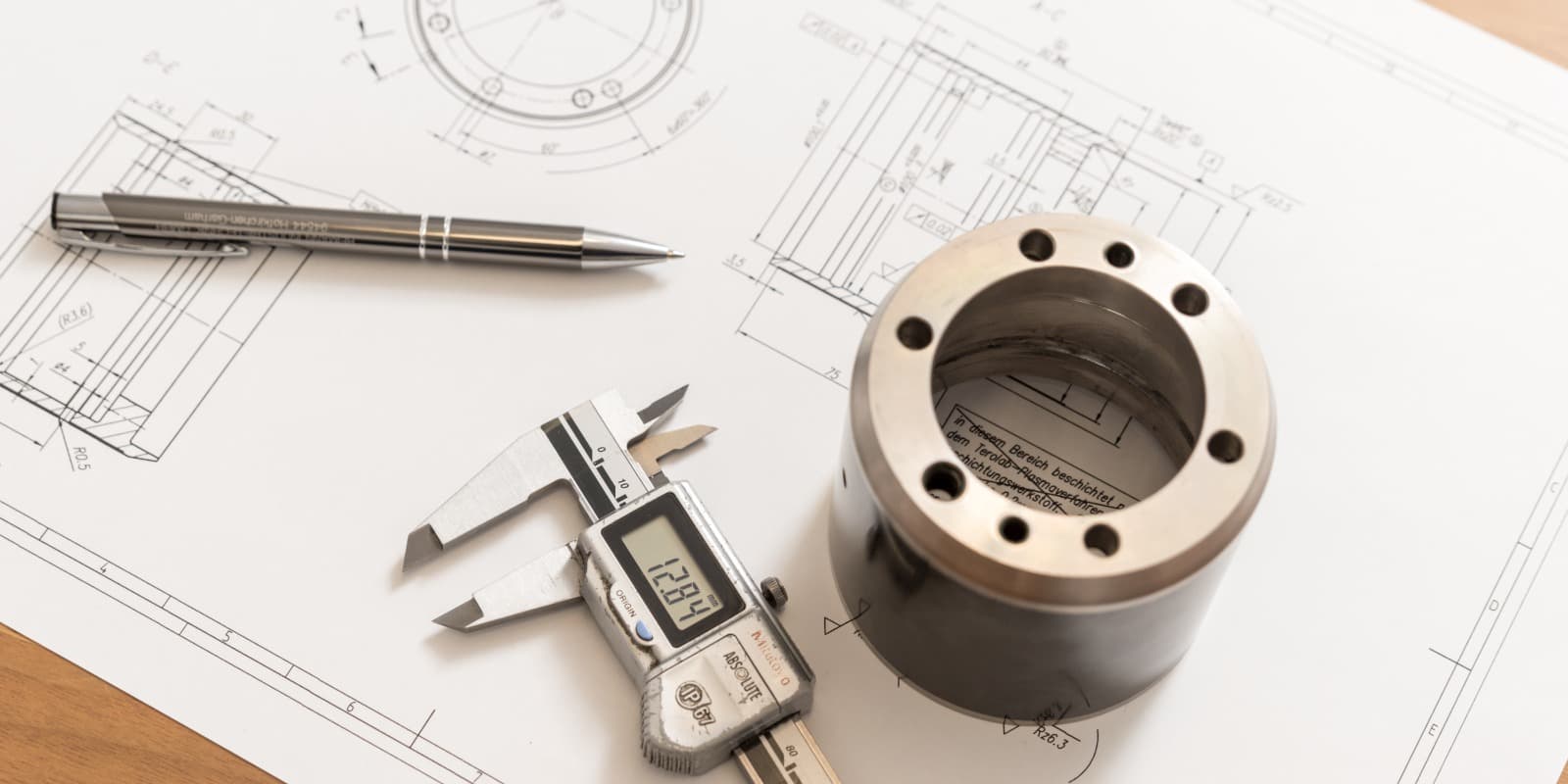
Post-processing
Do you have any questions?
ContactFrom printed part to functional component
Additively manufactured components made of high-performance plastics offer great design freedom. For many technical applications, however, the process does not end with printing: only targeted post-processing produces functional components with defined surfaces, tight tolerances and improved service properties.
We offer selected post-processing treatments for 3D printed plastic components, in particular for technical and high-temperature-resistant materials such as PEEK, PEKK and PEI/ULTEM. We carry out all processes in house, matched to material, geometry and application.
Our post-processing methods
Five processes, one goal: components ready for use.
Milling
Milling brings printed components to defined dimensions. Fitting and sealing surfaces, bores, pockets, grooves and reference surfaces are machined with the dimensional accuracy the application demands.
With high-temperature plastics in particular, the machining strategy is decisive. Sharp tools, adapted cutting parameters and suitable clamping minimise heat input, burr formation and distortion.
Grinding
Grinding improves surface quality and removes printing artefacts. Layer lines, support marks and minor irregularities are reduced until an even surface is achieved.
Depending on the requirements, we carry out coarse or fine grinding, specifically matched to the functional surfaces. Grinding also frequently serves as preparation for painting or impregnation.
Polishing
Polishing smooths pre-ground surfaces and improves appearance, feel and cleanability. It is particularly suitable for visible surfaces and for sliding areas where lower friction is required.
Polishing generally requires prior grinding. Depending on geometry and print quality, the original layer structure may remain partially visible.
Impregnation
Impregnation seals porous structures, voids and fine surface irregularities. This improves tightness, media resistance and cleanability and protects against the absorption of moisture and liquids.
We select the impregnation agent according to material, application, temperature load and media contact. With high-temperature plastics, the system must suit the later operating temperature.
Painting
Painting refines the surface visually and functionally: colouring to your specification, protection of the surface, covering of print marks or marking of components.
Good paint adhesion depends on the pretreatment. Depending on material and requirements, grinding, cleaning, primers or further adhesion preparations are used.
When post-processing pays off
Targeted post-processing improves dimensional accuracy, surface roughness, tightness and cleanability and prepares components for coating or assembly. In technical applications, what counts is not only appearance and feel but above all function, dimensional stability and resistance.
The processes are particularly suitable for fixtures and mounts, technical functional parts, prototypes with increased requirements, components with sealing or fitting surfaces, and small series and custom parts made of high-performance plastics.
The right process chain for your component
Which post-processing treatment makes sense depends on material, geometry, printing process and later application. That is why we work with you to determine which process chain delivers the desired benefit.
Depending on the requirements, we combine individual processes: milling and grinding for precise functional surfaces, grinding and polishing for smoother surfaces, grinding and impregnation for improved tightness, or milling, grinding and painting for technical components with visual demands.
Note on high-temperature plastics
High-performance plastics such as PEEK, PEKK or PEI/ULTEM are thermally and chemically very resistant. For exactly that reason, they can be more difficult to paint, impregnate or machine than standard plastics.
We therefore carefully match machining parameters, pretreatment and the materials used to the respective workpiece material.
Post-processing starts at the design stage
Later post-processing should be considered as early as the design of a 3D printed component. Machining allowances, clamping surfaces, wall thicknesses and functional areas can be planned so that precise and economical machining is possible.
We will be happy to support you in selecting suitable post-processing steps for your component.